MECHANISM #1. The Social Currency Switch
Here's what surprised me most in the research:
People don't refer you to help YOU. They refer you because it makes THEM look good.
When someone tells a friend about an amazing restaurant, they're not just being helpful.
They're building their reputation as someone who knows about amazing restaurants. They're positioning themselves as a connector, a tastemaker, someone in the know.
I’m the person who knows the good spots.”
“I’m the person who finds the good stuff first.”
That’s social currency.
And this is why “Can you refer me?” often backfires.
Because the second you ask, you accidentally make it about you.
You flip the switch OFF.
But when you position the referral as something that makes the other person look smart, generous, connected, or “in the know”…
The switch flips ON.
And referrals stop feeling like a favor. They start feeling like a flex.
Inside the playbook you're about to discover, you’ll see the simple ways to activate this switch—without sounding salesy or weird.
MECHANISM #2: The Reciprocity Trigger
This one is almost unfair.
When you give someone an unexpected win, perk, or “little gift”… they feel an internal pull to give back.
Not because they’re noble.
Because it’s human nature to want the relationship to feel balanced.
Most businesses hope referrals happen after someone is happy.
The smart ones create a few small “reciprocity moments” on purpose.
-- A surprise bonus.
-- A fast personal win.
-- A VIP upgrade they didn’t expect.
-- A helpful intro you make for them first.
-- A “you didn’t have to do that” moment.
Then when the referral moment shows up… it doesn’t feel like asking.
It feels like the natural next step.
In the playbook I'm about to hand over to you on a silver platter, you’ll get the specific reciprocity moves to use, and the best places to build them into your workflow (even as a side hustler).
It shows you exactly how to activate this switch in 6 specific ways.
MECHANISM #2. The Reciprocity Trigger
A Cornell professor ran a sneaky experiment. Participants rated paintings with a partner who was secretly a research assistant.
During the experiment, the assistant left and came back with a Coke for the participant.
Later, the assistant asked participants to buy raffle tickets.
People who got the free Coke bought DOUBLE the tickets.
A similar study found waiters who left mints on the bill increased tips by 23%.
This is the reciprocity principle. When someone gives us something, we feel an almost biological need to give back. We don't like feeling indebted.
The businesses getting the most referrals don't just deliver good service. They strategically create 'reciprocity moments' BEFORE ever mentioning referrals.
A discount when they land on your website. A surprise bonus after purchase. A birthday reward. VIP perks they didn't expect.
Then when the referral moment shows up… it doesn’t feel like asking.
It feels like the natural next step.
In the playbook you're about to receive you’ll get the specific reciprocity moves to use, and the best places to build them into your workflow (even as a side hustler).
MECHANISM #3. The Timing Windows
Most people ask for referrals at the worst possible time.
Too early (before results).
Too random (when nothing special just happened).
Or too late (after the emotional peak is gone).
But referrals don’t happen “whenever.” They happen in windows.
Research shows there are specific 'windows' when asking feels natural instead of awkward. When customers are psychologically primed to say yes.
The Dopamine Window: Right after you've delivered a win. The project launched. The deal closed. The tax refund came back big. In that moment, your customer is riding high. They WANT to help you.
The 'Thank You' Trigger: When a customer says 'thank you'—after a showing, when an offer gets accepted, at closing—that's your signal. They're expressing gratitude. They're happy. That's your moment.
The Commitment Window: When someone renews a contract or subscription, they've just recommitted to you. Their conviction is at a peak. Perfect time to ask them to share that conviction.
Ask at the wrong time, you feel pushy. Ask at the right time, you feel helpful.
In a second, you’ll see the playbook that maps the timing windows and shows you how to make referrals part of your normal routine… without awkward scripts or begging.
MECHANISM #4. The Pre-Frame (Borrowed Trust)
This is the secret weapon for people who don’t have customers yet.
Because not all referrals come from customers.
Some come from connectors. Partners. Group owners.
People who already have the audience you want.
And the difference between a weak referral and a powerful referral is one thing:
The frame.
A weak intro sounds like: “Hey, check this person out.”
A strong pre-frame sounds like:
“Pay attention—this is the person who helped me solve ___.”
“This will save you hours.”
“This is exactly what you were asking about.”
That one sentence changes everything: It turns a cold stranger into a warm introduction.
The playbook that's about to fall into your lap shows you how to create that pre-frame on purpose -- so other people sell the idea of you before you ever show up.
When you hit your referral formula right, here's what can happen.
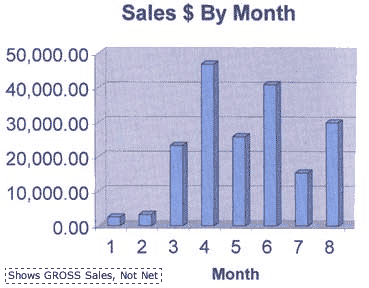
This is my own personal example of what happened the FIRST TIME I tapped into the raw, unabashed power of REFERRAL TRAFFIC:
I'm telling you what 's possible. What I and many others have done.
I'm NOT saying it's average. I have no proof it's realistic for you personally, since I don't know you. I can only show you what I've done and others have done very successfully.
But by way of complying with the law, I have to tell you it's not indicative of average results nor typical.
Pretty much, if you're an entrepreneur, you're a person who believes you defied the odds the day you were a zygote by beating out 10,000 other sperm.
So you aren't real concerned about "the odds" or what others do. First of all, most of them don't read more than a book a year, can't stick to a project longer than 10 days, and want money without work.